Introduction
For startups, DevOps and database reliability are not “nice to have”—they are foundational. From deployment automation to database performance and uptime, infrastructure decisions directly impact product velocity and customer trust.
Yet hiring senior DevOps engineers or database experts in-house is often slow, expensive, and difficult to scale. As a result, many startups turn to IT outsourcing firms to access specialized DevOps and database talent without delaying product development. For companies focusing on specific cloud ecosystems, hiring AWS development services can bridge the gap between initial build and scalable production.
This guide explains why startups outsource DevOps expertise, what roles are commonly outsourced, and how to evaluate outsourcing partners before committing.
Why Startups Outsource DevOps and Database Expertise
Startups move fast, but infrastructure mistakes compound quickly. Misconfigured pipelines, inefficient queries, or poor cloud architecture can create scaling bottlenecks that slow product releases.
High-performing teams leveraging modern CI/CD pipelines deploy up to 46 times more frequently. That velocity gap often determines whether a startup wins its market.
Outsourcing DevOps enables startups to:
- Accelerate deployments through optimized CI/CD pipelines
- Improve uptime and incident response processes
- Apply FinOps practices to control cloud spend
- Implement Shift Left Security in DevSecOps workflows
- Reduce operational risk without expanding fixed headcount
Instead of building infrastructure expertise from scratch, startups bring in senior specialists exactly when needed.
What Startups Should Look for in a DevOps Outsourcing Partner
Not all IT outsourcing firms are equipped to support modern DevOps environments. Startups should evaluate partners based on more than just technical tools.
Key considerations include:
- Hands-on senior expertise
Junior DevOps resources can introduce risk. Startups benefit most from senior engineers with production experience. - Startup readiness
Partners should understand rapid iteration, limited budgets, and evolving requirements. - Integration with internal teams
DevOps engineers must work closely with developers, product teams, and founders—not operate in isolation. - Security and compliance awareness
Infrastructure decisions must align with security best practices. Modern DevOps integration should focus on implementing DevSecOps primitives for microservices-based applications to ensure continuous authority to operate (C-ATO) in regulated environments. - Flexible engagement models
Startups need the ability to scale DevOps support up or down without long-term lock-ins. Choosing DevOps staff augmentation provides the agility required to survive rapid market shifts without the commitment of traditional full-time employment.
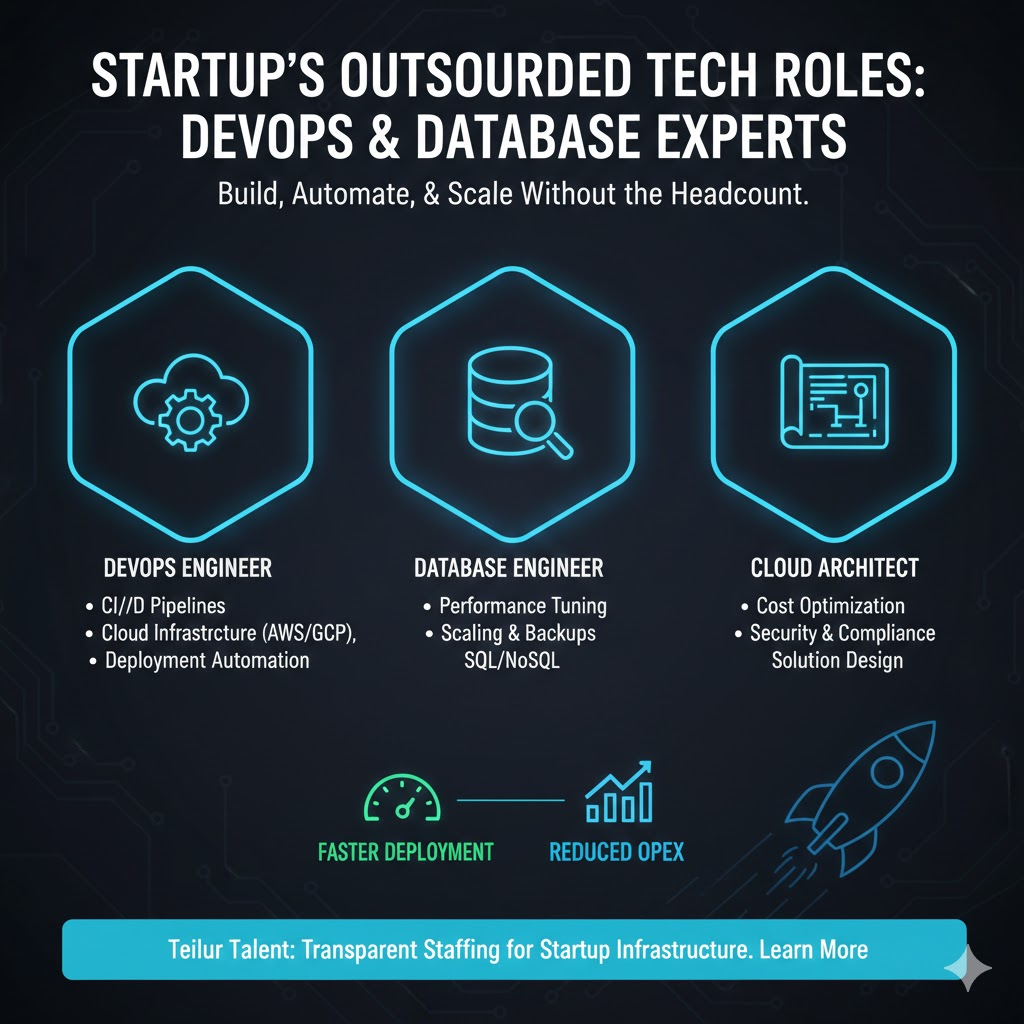
Common DevOps and Database Roles Startups Outsource
Outsourcing DevOps is rarely about delegating infrastructure entirely. Instead, startups often augment their teams with specialists who design scalable foundations and automate cloud operations. By bringing in these experts, founders avoid the "trial and error" phase that often leads to expensive cloud waste or security vulnerabilities.
Commonly outsourced roles include:
- Cloud Infrastructure Engineers Focusing on "Infrastructure as Code" (IaC) using tools like Terraform or Pulumi. They ensure that your cloud environment is reproducible, documented, and version-controlled from day one.
- DevOps Engineers The architects of speed. They design and maintain CI/CD pipelines and deployment workflows, allowing your developers to push code to production multiple times a day with zero downtime.
- Cloud Architects (AWS, GCP, Azure) High-level specialists who design cost-efficient and secure cloud environments. They are essential for startups transitioning from a monolithic setup to a microservices-based architecture.
- Site Reliability Engineers (SREs) The guardians of uptime. They focus on system reliability, automated monitoring, and incident response, ensuring that your cloud infrastructure can handle sudden traffic spikes without crashing.
By outsourcing these specialized cloud roles, startups gain access to senior expertise that would otherwise take months to recruit internally, allowing the core team to stay focused on product features rather than server maintenance.
Best IT Outsourcing Firms for Startups Needing DevOps Expertise
1. Teilur Talent
Best for: Startups seeking senior, full-time DevOps and database engineers with transparent pricing and fast onboarding.
Teilur Talent operates as a nearshore staff augmentation partner focused on senior DevOps and database talent from Latin America. Instead of project-based outsourcing, their model embeds engineers directly into startup teams, allowing founders to maintain full control over infrastructure decisions and priorities.
A key differentiator is Teilur’s Transparent Rate Pricing (80/20), where startups clearly see how compensation is distributed. This structure tends to improve retention and long-term commitment—critical factors when DevOps engineers are responsible for core infrastructure and data reliability.
Key strengths:
- Senior-only engineers with experience in CI/C and Infrastructure as Code (Terraform, CloudFormation).
- Pre-vetted candidates typically presented within 5 business days, balancing speed with technical and cultural fit.
- Month-to-month contracts designed to adapt to startup funding cycles.
- Strong alignment with U.S. time zones and high English proficiency, enabling close collaboration with product and engineering teams.
2. IT Svit
Best for: End-to-end DevOps managed services and cloud infrastructure optimization.
IT Svit is a boutique DevOps-focused firm offering DevOps-as-a-Service for startups that need comprehensive infrastructure support. They are particularly effective for cloud migrations, infrastructure audits, and performance optimization across AWS, Azure, and GCP environments.
Their team includes DevOps engineers, cloud architects, and database specialists who help startups stabilize and optimize infrastructure while controlling cloud costs.
Key strengths:
- Exclusive focus on DevOps and cloud consulting.
- Strong experience in infrastructure automation and monitoring.
- Solid expertise in database performance tuning and optimization.
3. Stern DevOps Group
Best for: Startups operating primarily on AWS that need reliability and cost optimization.
Stern DevOps Group is a boutique consultancy specializing in AWS environments. Their approach centers on senior-level consulting, with direct involvement from experienced engineers rather than large delivery teams.
They work closely with backend and platform teams to improve system reliability, database performance, and network security while identifying unnecessary infrastructure spend.
Key strengths:
- Deep specialization in AWS services and architecture.
- Combined expertise in backend infrastructure, databases, and security.
- Hands-on, senior-led consulting model.
4. Vention
Best for: High-growth startups scaling large DevOps and infrastructure teams.
Vention is a global outsourcing provider with a large talent pool, making it suitable for startups that need to scale DevOps and database capabilities rapidly. Their model supports building entire engineering “pods” that include DevOps, backend, and database specialists.
This option is often chosen by startups that have reached later growth stages and require multi-region infrastructure management.
Key strengths:
- Access to a large global engineering workforce.
- Ability to scale DevOps teams quickly.
- Experience supporting Series A to Series D startups.
5. Alpacked
Best for: Cloud-native startups using Kubernetes and container-based architectures.
Alpacked focuses on modern cloud-native infrastructure, helping startups deploy, manage, and scale systems built around Kubernetes, Docker, and CI/CD pipelines. Their emphasis on low staff turnover helps ensure infrastructure knowledge remains stable over time.
They are particularly well-suited for startups dealing with complex deployment workflows and container orchestration challenges.
Key strengths:
- Deep expertise in Kubernetes and container orchestration.
- Strong focus on CI/CD best practices.
- Agile collaboration and transparent communication.
Pricing Models and Flexibility for Startups
Pricing structure is often the deciding factor in DevOps outsourcing. Startups require models that prioritize agility and cost-predictability over rigid, long-term commitments. Implementing automated resource scaling and rightsizing through these models can lead to infrastructure cost reductions of up to 44.7%.
When comparing providers, the level of transparency and upfront friction varies significantly:
- Teilur Talent vs. Revelo: While both offer Latin American talent, Teilur Talent operates with no upfront fees and a transparent 80/20 markup, ensuring the majority of your budget goes directly to the engineer. In contrast, platforms like Revelo typically require a $500 non-refundable deposit to start a search and use "blended rates" that hide the platform's exact margin.
- Staff Augmentation vs. Managed Services (IT Svit/Vention): For startups needing full operational control, the Staff Augmentation model (used by Teilur) is more flexible than the Monthly Retainers or Fixed-Price models often found at IT Svit. While firms like Vention are built for scaling large engineering "pods" for Series B+ companies, early-stage startups often prefer the Time-and-Materials or month-to-month flexibility of boutique partners to avoid long-term lock-ins.
Choosing the Right Engagement Model
Founders should weigh the administrative benefits of EoR (Employer of Record) vs. recruiting agencies to determine which handles international compliance and payroll most effectively. Ultimately, flexible pricing allows startups to experiment and scale infrastructure responsibly—without committing to permanent headcount too early.
FAQ
Is outsourcing DevOps safe for startups?
Yes. Reputable partners follow ISO/IEC 27017 guidelines for information security controls specifically designed for cloud services, which establish clear shared responsibilities between the provider and the client.
Can outsourced DevOps engineers work with our existing team?
Absolutely. Most modern DevOps outsourcing models are designed for close collaboration and embedded workflows.
Do startups still need in-house DevOps long-term?
Some do, but many continue using outsourced or augmented DevOps talent as their infrastructure evolves.
Conclusion
DevOps and database expertise are critical to startup success—but hiring internally is not always the fastest or most efficient option. Outsourcing allows startups to access senior infrastructure talent, improve reliability, and scale responsibly without slowing down product development.
The key is choosing an IT outsourcing partner that understands startup environments. For a detailed comparison of regional leaders, see our guide on the top 5 best companies for outsourcing tech talent to Latin America
Looking to build your remote team in Latin America without hidden fees or inflated markups?
At Teilur Talent, our Transparent Rate Pricing model ensures you know exactly where every dollar goes — with at least 80% of the rate going directly to the talent. This means fair pay, full visibility, and stronger long-term partnerships that drive real growth. We connect you with vetted, English-proficient professionals in tech, marketing and business ops who are ready to scale your operations seamlessly and cost-effectively.
If you’re ready to experience a smarter way to hire, click here to schedule a free consultation with us.