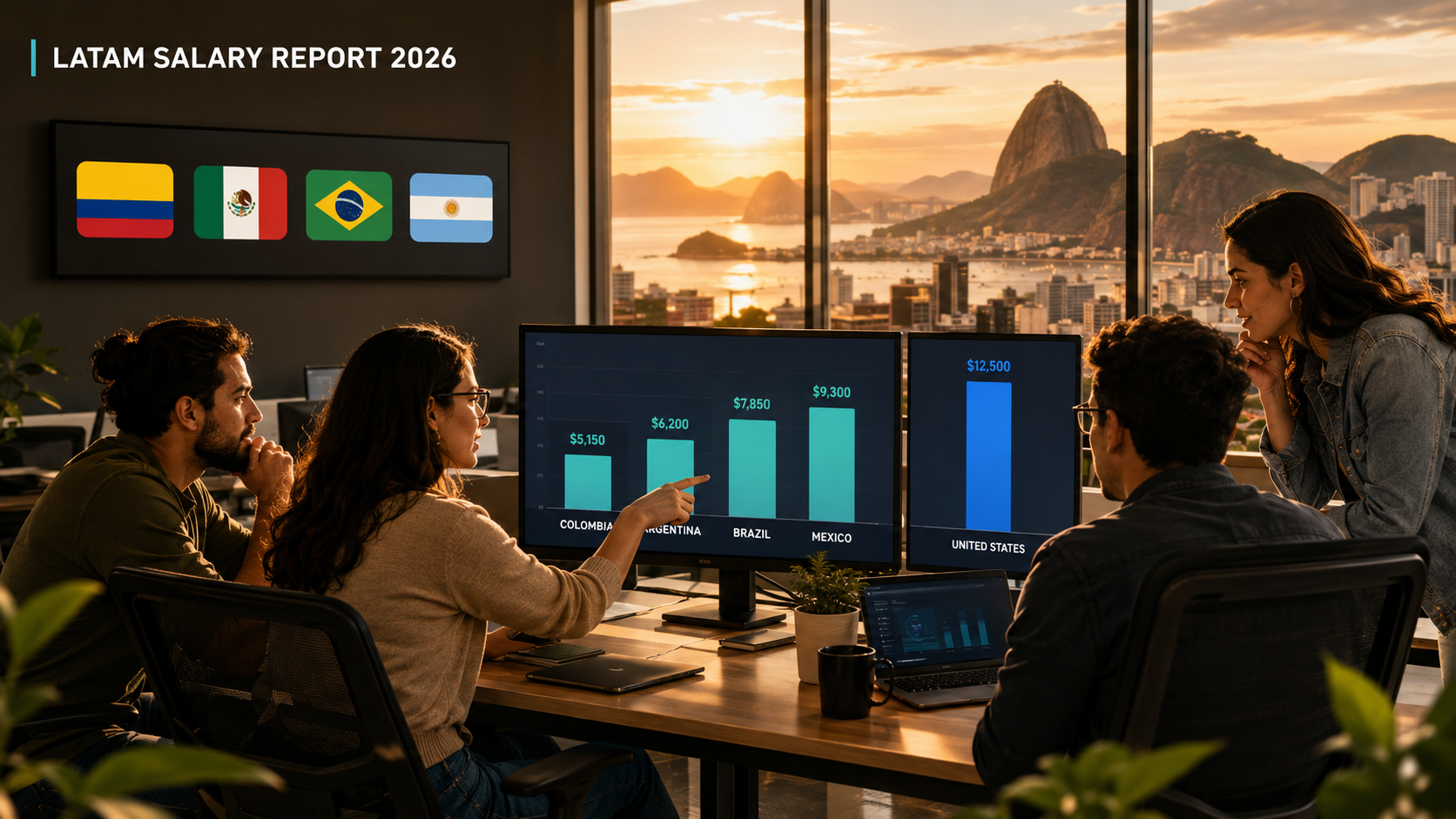
Colombia vs Mexico Hiring Cost Comparison (2026)
If you’re building a remote engineering team in Latin America, two countries consistently rise to the top: Colombia and Mexico. Both offer strong talent pools, time-zone alignment with the U.S., and competitive costs—but choosing between them is not just about salary.
In 2026, the real decision comes down to total hiring cost, employer burden, talent availability, and operational complexity. Many companies make the mistake of comparing only base salaries, overlooking taxes, benefits, and hidden costs that can significantly impact their budget.
In this guide, we break down the true cost of hiring in Colombia vs Mexico, so you can make a smarter, data-driven decision.
Colombia vs Mexico: Talent Market Overview
Both Colombia and Mexico have developed into leading tech hubs in LATAM, but they differ in scale and positioning.
- Mexico
- Larger talent pool
- Strong proximity to the U.S. (both geographically and culturally)
- High concentration of senior engineers
- More mature enterprise and outsourcing ecosystem
- Colombia
- Fast-growing tech ecosystem
- Strong pipeline of mid-level and senior developers
- High adaptability and cultural alignment with U.S. teams
- Increasing English proficiency.
In general, Mexico offers scale, while Colombia offers cost-efficiency with strong quality.
| Country |
Mid-Level (3-5 years) |
Senior (5-8+ years) |
Specialized (AI/ML/Arch) |
| Brazil |
$4,500 - $6,000 |
$7,500 - $10,500 |
$11,500+ |
| Mexico |
$4,800 - $6,500 |
$8,000 - $11,000 |
$12,000+ |
| Colombia |
$4,000 - $5,500 |
$7,000 - $9,500 |
$10,500+ |
| Argentina |
$3,800 - $5,200 |
$6,500 - $9,000 |
$10,000+ |
| Feature |
Teilur Talent |
Deel (EOR Model) |
| Pricing Structure |
Transparent 80/20 Split |
Flat Fee / Markups |
| Talent Visibility |
Direct access to salary data |
Cost usually bundled |
| Retention Strategy |
Fair-pay & culture-focused |
Compliance-focused |
| Geographic Depth |
LATAM Specialists |
General Global Coverage |
| Seniority Level |
Monthly Total Cost (USD) |
Annual Total Cost (USD) |
Experience / Profile |
| Mid-Level |
$4,000 – $6,000 |
$48,000 – $72,000 |
3–6 years; Strong English; FinTech or Cloud focus. |
| Senior |
$6,300 – $9,600 |
$75,600 – $115,200 |
6+ years; Lead experience; Architecture & Mentorship. |
| Specialized (AI/ML) |
$9,200 – $13,800 |
$110,400 – $165,600 |
Experts in LLMs, Data Engineering, or Cybersecurity. |
| Seniority Level |
Monthly Total Cost (USD) |
Annual Total Cost (USD) |
Experience / Profile |
| Mid-Level |
$3,800 – $5,800 |
$45,600 – $69,600 |
3–6 years; Independent; Full-stack or Backend focus. |
| Senior |
$6,200 – $9,500 |
$74,400 – $114,000 |
6+ years; Lead experience; Architecture & Mentorship. |
| Specialized (AI/Cloud) |
$9,000 – $13,500 |
$108,000 – $162,000 |
Experts in AI Integration, AWS/Azure, or Cybersecurity. |
| Feature |
Nearshore |
Offshore |
EOR (Employer of Record) |
Direct Hire |
| Time Zone |
Same/Overlap (±2 hrs) |
Significant Gap (+10 hrs) |
Varies by location |
Local to HQ |
| Speed to Hire |
1–3 Weeks |
2–4 Weeks |
2–6 Weeks |
2–4 Months |
| Operational Control |
High (Real-time) |
Medium (Asynchronous) |
Low (Legal focus) |
Maximum |
| Compliance Risk |
Managed by Partner |
High (Variable) |
Zero (Legal Shield) |
Internal Responsibility |
| Cost |
Mid-range |
Lowest |
Moderate (Fees apply) |
Highest (Tax + Benefits) |
Salary Benchmarks: Colombia vs Mexico (2026)
The following tables present the projected monthly cost of engagement for software development roles in 2026. These figures include the Total Payment (Candidate Salary + Teilur’s Fee), reflecting a comprehensive nearshore budget based on actual data from our cost calculator.
While the specific salary for any given role is determined by the candidate’s accepted offer, these ranges provide a robust framework for U.S. companies budgeting for high-quality engineering talent.
Colombia
Our current data shows a strong, cost-effective entry point for Mid-Level roles in Colombia. As the ecosystem matures and specialized demand grows, we project the following ranges for 2026:
| Model |
Time to Hire |
Cost Structure |
Compliance Risk |
Operational Complexity |
Scalability |
| Employer of Record (EOR) |
Days |
Predictable fee |
Low |
Low |
High |
| Contractors |
Immediate |
Low upfront |
High |
Low initially, high later |
Low |
| Legal Entity |
Weeks–Months |
High upfront + ongoing |
Low |
High |
High |
|
Seniority
|
Total Monthly Payment Range
|
|
Mid-Level (Tactical Execution)
|
$4,375 – $6,000
|
|
Senior (Strategic Leadership)
|
$7,500 – $10,000
|
|
Specialized (AI/ML/Cybersecurity)
|
$11,000+
|
| Seniority Level |
Monthly Total Cost (USD) |
Annual Total Cost (USD) |
Experience / Profile |
| Mid-Level |
$4,200 – $6,200 |
$50,400 – $74,400 |
3–6 years; Strong English; Independent contributor. |
| Senior |
$6,500 – $9,800 |
$78,000 – $117,600 |
6+ years; Lead experience; Systems Architecture. |
| Specialized (AI/ML) |
$9,500 – $14,000 |
$114,000 – $168,000 |
Deep expertise in LLMs, MLOps, or Cloud Security. |
Note: Current calculator data shows a total expected monthly cost of $4,375 for a Mid-Level Cybersecurity role in Colombia, providing a concrete baseline for the lower end of the projected 2026 range.
Mexico
As the largest nearby tech market, Mexico naturally commands slightly higher rates due to a more competitive enterprise landscape and deeper integration with North American time zones and industries:
|
Seniority
|
Total Monthly Payment Range
|
|
Mid-Level (Tactical Execution)
|
$5,000 – $7,000
|
|
Senior (Strategic Leadership)
|
$8,500 – $11,500
|
|
Specialized (AI/ML/Cybersecurity)
|
$12,500+
|
EOR vs. Staff Augmentation: Key Differences
| Factor |
EOR (Employer of Record) |
Staff Augmentation (Teilur) |
| Talent Sourcing |
You provide the candidate. The EOR serves as the legal infrastructure for a hire you've already found. |
We provide the candidate. Includes proactive sourcing, technical vetting, and expert matching. |
| Cost |
Salary + platform fees + compliance. Bundled pricing often obscures the developer's actual take-home pay. |
Transparent 80/20 model. Full visibility into salaries and statutory benefits. No hidden markups. |
| Control |
Legal employment handled externally. Limited involvement in daily performance or cultural fit. |
Full control over selection. Partner supports retention and cultural integration within your team. |
| Scalability |
Best for distributed compliance across multiple jurisdictions. |
Superior for building stable, high-retention engineering hubs in Latin America. |
EOR vs. Staff Augmentation: Key Differences
| Factor |
EOR (Employer of Record) |
Staff Augmentation (Teilur) |
| Talent Sourcing |
You provide the candidate. The EOR serves as the legal infrastructure for a hire you've already found. |
We provide the candidate. Includes proactive sourcing, technical vetting, and expert matching. |
| Cost |
Salary + platform fees + compliance. Bundled pricing often obscures the developer's actual take-home pay. |
Transparent 80/20 model. Full visibility into salaries and statutory benefits. No hidden markups. |
| Control |
Legal employment handled externally. Limited involvement in daily performance or cultural fit. |
Full control over selection. Partner supports retention and cultural integration within your team. |
| Scalability |
Best for distributed compliance across multiple jurisdictions. |
Superior for building stable, high-retention engineering hubs in Latin America. |
Remote vs. Direct Hire in LATAM: Quick Comparison
| Feature |
Remote Hiring (Contractors/EOR) |
Direct Hiring (Teilur Talent) |
| Cost |
Simpler upfront, but fees can hide markups. |
Full control. Use the Teilur Salary Calculator to see real costs. |
| Compliance |
Reduces legal complexity for temporary setups. |
Deeper alignment with local labor laws, taxes, and mandatory benefits. |
| Scalability |
Better for speed and short-term flexibility. |
Aligned with global trends for stable, high-retention engineering hubs. |
| Best Fit |
Small or experimental distributed teams. |
Startups building durable presence and internal culture in LATAM. |
| Hybrid Option |
Many companies start with remote hiring and transition to a direct structure as they scale.
|
Toptal vs Teilur Talent Comparison
| Concept |
Toptal |
Teilur Talent |
| Transparency |
Pricing details are not publicly disclosed. Clients see a blended hourly rate that includes both Toptal’s fee and the freelancer’s pay. |
Fully transparent rate breakdown. Clients see exactly how much goes to the talent and how much is retained by Teilur as a service fee. |
| Commission / Markup |
Estimated at up to ~50% based on third-party reports and client testimonials. The exact markup percentage is not officially stated. |
Capped at 20%, ensuring that at least 80% of the client’s payment goes directly to the developer. |
| Monthly Subscription Fee |
$79/month, non-optional, grants access to Toptal’s vetted talent network. (Source: Toptal website). |
No subscription fees. Clients only pay when hiring or engaging talent. |
| Initial Deposit |
$500 refundable deposit required to begin a talent search. |
No upfront deposit required to start the matching process. |
| Trial Policy |
Two-week no-risk trial. Clients are billed only if satisfied with the match. |
N/A (direct matching) – Teilur focuses on pre-vetted, long-term placements with transparent trial terms discussed case by case. |
| Pricing Range (Developers) |
$60–$200+ per hour depending on experience and project complexity (includes platform markup). |
$6,000–$7,000/month for senior LATAM developers, equivalent to ~$35–$45/hour — transparent, with no hidden markups. |
| Payment Structure |
Bi-monthly invoices; payment terms like Net 10. Includes blended rate. |
Monthly invoices with clear cost breakdown (talent pay + Teilur fee). |
Note: Current calculator data shows a total expected monthly cost of $5,000 for a Mid-Level Cybersecurity role in Mexico, confirming a roughly 14% higher baseline than Colombia for this specific position.
Key Insight: Regional Cost Disparity
A systematic comparison of roles at identical seniority levels confirms that Mexico remains the higher-cost market. U.S. startups must account for this discrepancy when choosing a sourcing destination.
On average, base salaries in Mexico are 12% to 18% higher than in Colombia for comparable engineering roles.
While this means Mexico requires a higher initial investment, it also generally indicates a larger talent pool for Senior roles and a more established tech hub infrastructure in key cities like Guadalajara and Mexico City. This disparity must be balanced against your specific needs for scale versus budget efficiency.
Total Hiring Cost: Taxes, Benefits & Employer Burden
Salary is only part of the equation. Each country has its own employer taxes and mandatory benefits, which significantly increases the total cost of engagement. Understanding these "hidden" percentages is vital to avoid budget overruns and ensuring long-term compliance.
Colombia Employer Burden (~40%–50%)
Colombia has one of the most robust social protection systems in the region, designed to provide long-term security for the developer.
- Social Security: Includes Health (8.5%), Pension (12%), and ARL (risk insurance, typically 0.5% for remote tech roles).
- Parafiscales: Mandatory contributions to government-backed social programs (SENA, ICBF, and Caja de Compensación) totaling 9%.
- Deferred Compensation: This includes Severance (Cesantías) and the Prima (a 13th-month salary equivalent paid in two installments), which are legally non-negotiable.
- Paid Vacation: A mandatory 15 working days per year (~4.17% of annual cost).
Mexico Employer Burden (~30%–40%)
While Mexico's base percentages may seem lower, they are integrated into a federal system that emphasizes housing and retirement stability.
- Social Security (IMSS): The core contribution covering health and disability, which varies slightly based on the salary base.
- Housing Fund (INFONAVIT): A mandatory 5% contribution to the federal employee housing program.
- Retirement & Old Age: Contributions that ensure the developer’s long-term financial health.
- Aguinaldo (Annual Bonus): A mandatory year-end bonus of at least 15 days' salary, a cornerstone of Mexican labor law.
- Vacation Premium: Beyond paid days off, employers must pay a 25% premium over the salary during the vacation period.
|
Country
|
Base Salary
|
Employer Burden
|
Total Cost
|
|
Colombia
|
$5,000
|
+45%
|
~$7,250
|
|
Mexico
|
$5,500
|
+35%
|
~$7,425
|
Toptal vs Teilur Talent Comparison
| Concept |
Toptal |
Teilur Talent |
| Business Model |
Global freelance marketplace connecting clients with vetted professionals in software, design, and finance. |
LATAM-focused recruitment company connecting businesses with full-time remote developers and tech professionals. |
| Selectivity Claim |
Claims to accept less than 3% of applicants, based on its internal screening process. |
Works only with pre-vetted, bilingual professionals in LATAM, selected for technical and communication skills. |
| Recruitment Process |
Multi-stage: timed skills test → English interview → real-world project → live screen evaluation. |
Direct evaluation of experience, portfolio, and communication ability. Matches candidates by vertical (QA, Software, Cybersecurity, Data & BI) and company culture. |
| Trial or Test Period |
Offers a two-week trial, refundable if client isn’t satisfied. |
No fixed trial period — focuses on long-term retention and transparent onboarding. |
| Contract Type |
Typically weekly contracts (20 or 40 hours) with limited flexibility for short-term projects. |
Flexible monthly agreements, allowing scalability per project scope and company needs. |
| Transparency |
Pricing details not publicly disclosed. Clients see a blended hourly rate including Toptal’s markup. |
Fully transparent pricing model. Clients see how much goes to the developer and how much is Teilur’s service fee. |
| Commission / Markup |
Estimated around 40–50%, based on user reports and external reviews. |
Capped at 20%. At least 80% of client payment goes directly to the developer. |
| Initial Deposit |
Requires a $500 refundable deposit to start the search process. |
No upfront deposit required. |
| Client Support |
Account managers available during hiring and engagement. Support quality varies by project. |
Personalized support from start to finish, ensuring alignment for both client and talent. |
| Developer Pay Transparency |
Developers are contractually restricted from disclosing their actual pay rates. |
Developers know their full compensation and see transparent rate breakdowns. |
| Geographic Focus |
Global, with talent from Eastern Europe, Asia, and LATAM. |
Exclusive to Latin America, optimizing time-zone alignment and cultural fit. |
| Turnover Rate |
Not publicly disclosed. |
Reported below 15%, reflecting strong retention and satisfaction. |
| Best For |
Large enterprises or teams needing globally distributed freelance specialists. |
U.S. and international companies seeking transparent, long-term partnerships with vetted LATAM developers. |
Key insight:
Even though Colombia has a higher employer burden, lower base salaries often make total costs similar or slightly lower than Mexico.
Hidden Costs and Operational Differences
Beyond salary and taxes, there are additional costs that can impact your hiring strategy:
- Compliance & Legal Risk
Each country has different labor laws. Misclassification or errors can lead to fines or liabilities. - Payroll & Administration
Managing payments, contracts, and benefits across countries adds operational overhead. - Talent Retention
Lack of salary transparency or unfair compensation can increase turnover. - Agency Markups
Traditional staffing agencies often take 30%–50% of the budget, without clear visibility into how funds are allocated.
One effective way companies are reducing these hidden costs is by working with more transparent hiring models. For example, Teilur Talent offers a cost-efficient alternative through its 80/20 pricing structure, where most of the budget goes directly to the developer.
Conclusion: Colombia vs Mexico, Which One Is Better?
There is no universal winner—but there is a better choice depending on your priorities.
- Choose Colombia if:
- You want better cost-efficiency
- You are building a scalable engineering team
- You prioritize long-term value
- Choose Mexico if:
- You need access to a larger talent pool
- You want more senior-level availability
- You value geographic proximity to the U.S.
In 2026, the smartest companies are not choosing based on salary alone. They are optimizing for total cost, transparency, and long-term team performance.
FAQ
Which country is cheaper to hire developers: Colombia or Mexico?
Colombia is generally more cost-efficient due to lower base salaries, although total costs can be similar depending on employer taxes and role seniority.
Is the talent quality better in Mexico or Colombia?
Both countries offer high-quality talent. Mexico has a larger and more mature market, while Colombia offers strong, fast-growing talent with competitive costs.
How can companies reduce hiring costs in Colombia or Mexico?
Companies can reduce costs by improving cost transparency and avoiding hidden agency markups. Working with partners like Teilur Talent can help, as they provide vetted LATAM developers with a transparent pricing model, ensuring better cost control, higher retention, and full visibility into how your budget is allocated.
Looking to build your remote team in Latin America without hidden fees or inflated markups?
At Teilur Talent, our Transparent Rate Pricing model ensures you know exactly where every dollar goes — with at least 80% of the rate going directly to the talent. This means fair pay, full visibility, and stronger long-term partnerships that drive real growth. We connect you with vetted, English-proficient professionals in tech, marketing and business ops who are ready to scale your operations seamlessly and cost-effectively.
If you’re ready to experience a smarter way to hire, click here to schedule a free consultation with us.